
CURRENT NEWS
Autumn 1 - Super Me!
English
In English this half term, we will be revising the phonics we did in Year 1 and developing our independent reading and writing skills through using a range of the wonderful and exciting books to get us off to a great start! We will be finishing off our Level 5 Phoneme revision and then be moving to Level 6 phonics teaching and learning for the rest of the year - we will be super readers and spellers soon!
We will be continue to develop our reading skills in both independent reading to adults and our weekly guided reading sessions as well as in our weekly library time - don't forget to read your 2 reading books as many times as you can each week to become a confident and fluent reader! We will be learning all about the features of letters, non-chronological reports, letters, character descriptions as well as instructions.
Check out our Class Reading Journey on this page to find out the range of wonderful books we will be reading together all year. We will be working hard on beginning to use pre-cursive writing, learning all about adjectives, conjunctions as well as making sure we become experts at using capital letters and full stops when we are writing recounts, stories, letters and instructions.
We will also revise all our Year 1 Common Exception words and begin our journey to learn to read and spell the Year 2 Common Exceptions words and as we move onto Level 6 of our school Twinkl Phonics scheme, we will have lots of opportunities to revise and practice these tricky words.
Year 2 Class Reading Journey:
Maths
Maths
In Maths this half term, we will begin to secure our rapid recall of our 10,2 and 5s times tables to support us in our work on multiplication and division and begin to learn our double facts off by heart. We will learn all about methods to help us add and subtract 2-digit numbers and how to use known number facts to become confident when solving maths calculations in our heads. We will also be learning how to tell the time, and about how to measure length and capacity too!
We will also work daily on our maths fluency skills to help us become more confident when adding, subtracting, multiplying and dividing. Check out the Year 2 Maths Knowledge organisers on this page to see where our Year 2 maths journey will take us.
Science - Animals including humans
Year 2 pupils will learn about the basic needs of animals, including humans, the importance of exercise, healthy eating and hygiene, and how offspring grow into adults. They will develop their scientific knowledge by observing, identifying, comparing and classifying animals, asking questions, making simple predictions and recording their findings from practical investigations. Practical learning opportunities include investigating the effect of exercise on pulse rate, sorting foods into healthy and less healthy groups, observing changes in living things over time, and carrying out simple hygiene experiments such as testing how effectively different handwashing methods remove glitter or UV gel to represent germs.
Geography
Super UK!
The children will learn to recognise landmarks and physical features of UK using maps and aerial photographs (What does Superman see as he’s flying to the rescue?) Naming capital cities of UK and continents and key features of a place. We will also be studying our local area and conducting surveys within the community to determine whether Littleborough is a town, city or village, as well as identifying and naming local landmarks, and human and physical features around us,
Mapping skills covered:
- name and locate the world’s seven continents and five oceans
- name, locate and identify characteristics of the four countries and capital cities of the United Kingdom and its surrounding seas.
- use world maps, atlases and globes to identify the United Kingdom and its countries, as well as the countries, continents and oceans studied at this key stage
R.E.
Unit 1: What do Christians believe God is like?
Our Christian value for this half term is all about Responsibility. Through a combination of whole school worship, stories and work in class, we will begin the year by thinking about how we can be a responsible member of our class and responsible in our friendships too.
In our R.E. sessions, we will be considering what Christians believe God is like, exploring and explaining our own perceptions and how God is represented in the Bible, and the story of Creation.
Music (linked to our Science topic - Animals including humans
Year 2 pupils will learn to identify, create and organise animal-inspired sounds using their voices, body percussion and a range of instruments to represent different animals and habitats. They will develop their listening, performing and composing skills by exploring rhythm, dynamics, tempo and timbre, working both independently and collaboratively. Through practical music-making, performance and reflection, children will build confidence in expressing musical ideas and evaluating how effectively sounds communicate meaning.
Computing (Mrs Bester)
Technology in the world
In Computing this half term with Mrs Bester, we will be learning all about this unit How is information technology (IT) being used for good in our lives?
Computing systems and networks – IT around us
Art
In our art lessons this half term, we will be developing our drawing skills and begin to learn the different methods that can represent texture and emotions of characters, using a range of different media. Here are the learning objectives we will be focusing on:
Tell a Story – drawing skills Suggest ways to draw a word through marks.
- Use relevant language to describe how an object
- Suggest ways to create different textures through
- drawn marks.
- Freely experiment with different tools, receiving
- encouragement when needed.
- Describe and then draw shapes that make up an
- Use good observational skills to add details to their
- Use an interesting range of marks that show an
- understanding of how to draw different textures.
- Make sketches, which may be of basic stick-like
- figures or may imply more shapes.
- Develop sketches into a character, with some
- support, adding details to enhance their character.
- Demonstrate an understanding of how drawing
- facial features in different ways conveys expressions.
- Recount a story and select key events to draw.
- Create scenes from their own imagination, with some support.
PSHCE
In our PSHCE sessions this half term with Mrs Bester, we will learn about and celebrate the different kinds of families, consider the qualities we need to have to be a good friend to others, alongside what qualities we look for in our friends and why.
Unit 2 families and relationships - by the end of this unit, children will be able to:
Pupils who are secure will be able to:
- Understand that families offer love and support
- and that different families may be made up of
- different people.
- Consider what friends may be thinking and feeling
- in different situations.
- Recognise some issues that may occur in
- friendships and which of these may need adult
- help to resolve.
- Understand that expectations of manners may
- change according to the situation.
- Know that remembering people who were
- important to them but are no longer here can
- cause a mixture of emotions.
- Explain what gender stereotypes are in relation to
- careers
ONLINE LEARNING
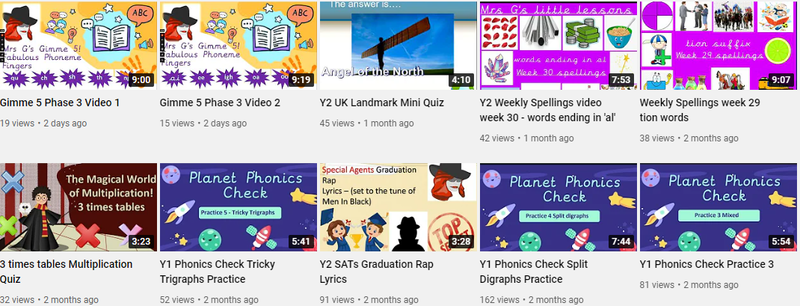
Weekly little lesson over on Mrs G's Little Lessons Youtube channel to help you practice your weekly spellings at home and links to other usual learning videos will be posted regularly on our class Seesaw page.
Check out the different spelling, phonics and maths playlists videos and little lessons on YouTube here:

READING
Reading is the cornerstone of all the children do and learn to do in Year 2. As children are expected to leave Year 2 on Stage 10 or higher, it is vital that children read at home as much as possible. Regular reading also helps children to learn the high frequency and common exception words that the children need to be able to read and spell, as well as modelling coherent sentence structures. Children need to become more fluent when reading aloud, and should only need to sound out a few words within the book.
From September, we will be assessing the children's reading and matching their reading books to their current phonetical knowledge. We group the children in class into 2 groups and endeavor to change reading books at least twice a week on a daily alternating basis, to ensure your child's book is changed when needed, please remember to record all reading in the blue reading diary.
It is also really important that your child reads as much as they can - these books do not need to be the school reading book, and I would encourage you to share your favourite books or authors with your children. In the next few weeks, I will be inviting parents (who wish to) to come and read their favourite children's book to the class at home time - to show children that books and stories should be enjoyed and loved! If you would be interested in this, please pop in and see me any time - the children and I would love to have you!
Homework and Spellings
In Year 2, it is very important that the children complete their homework including spellings and reading their homework book every week. At the end of the year, the children will be taking their SATs tests which include separate reading and spelling tests. The outcome of these tests supplement my end of year decisions - spelling plays a big factor in whether or not your child will reach the expected level for Year 2 by the end of the year. At Parent's evening later on this half-term, I will be sending home the lists of High Frequency words and the newer 'Common Exception words' for your child to practice reading and spelling at home to consolidate the work done in class as well as intervention groups. (Please see below for the list of words.)
Revising Year 1 Learning Home support:
This half term, your child will begin the year revising the phonics they learnt in Year 1 to help develop their confidence in both their independent reading and writing. A core skill we will be focusing on is teaching the children to use their phoneme fingers to sound out words when spelling independently. In class, we will be completing phonics fluency tasks that focus in on 5 words that include the same sound and the children have to write down the graphemes for the sounds they can hear. I will also be uploading the Gimme 5 Mini lessons on a regular basis to help your child be able to practice at home and begin their journey to become a Super Speller. Check out the most recent uploads to help you with your sounding out:
https://www.youtube.com/playlist?list=PLDNY9D-fYJHzpjh__CiVcvUyipeX98BBW
Phonics Information for Parents:
Please continue practicing using all the phonics resources we will be sending home in September and don't forget I love to see those videos on the Seesaw app.
You can also visit this website to play some phonics games:
Year 2 Common Exception words
These are all the words your child will need to be able to read and spell correctly when writing independently in class, your child may also refer to these as 'rainbow words' too as this is what we call them in class. Keep your eye out for Rainbow word challenges on Seesaw throughout this half term!
TIMES TABLES CHALLENGES:
In Year 2, the children need to know their multiplication and division facts for the 10,2,5 and 3 times tables.
Fancy practicing your timetables facts? Check out these games here:
https://www.topmarks.co.uk/maths-games/5-7-years/multiplication-and-division
Want to find out a little more about what Year 2 is going to be like, and what your child will be learning in maths and spelling? Check out these handy Parent guides below:
What will my child learn in Year 2?
https://home.oxfordowl.co.uk/at-school/year-2-at-primary-school/what-to-expect-in-year-2-age-6-7/
More about Year 2 maths:
https://home.oxfordowl.co.uk/maths/primary-maths-age-6-7-year-2/
More about Year 2 spelling:
